
Subiyay, Not the Last Tree
On the Skokomish Reservation, one man spent a lifetime refusing to let his culture disappear

At the northwest corner of the continental United States sits a geographic marvel: the Olympic Peninsula. Towering peaks rise at its center, surrounded by one of the only temperate rainforests in North America. To the north lies the Strait of Juan de Fuca, to the west the open Pacific, and along its eastern flank runs Hood Canal, not a canal at all, but a long, glacially carved fjord separating the Peninsula from the rest of Washington State like a moat.
The Olympic Peninsula has been home to humans for at least ten thousand years. Its Indigenous peoples, though neighbors on the same rugged landscape, were not a single people but distinct nations, each shaped by their particular relationship to the land and water around them. Along the outer Pacific coast were the Quinault*, masters of the river and the open ocean. At the northwestern tip, the Makah* built a culture around deep-sea whaling, venturing into the Pacific in cedar canoes to hunt gray and humpback whales. And along the sheltered waters of Hood Canal lived the Twana, a people of the inland sea, of salmon rivers and cedar forests, and the calm, cold waters of the canal itself. It is from the Twana that the Skokomish descend, their name meaning, simply, “people of the river.” It is at the mouth of the Skokomish River, where it meets the Great Bend of Hood Canal, that they have lived since before memory begins.
In 1792, British naval officer George Vancouver sailed Hood Canal. The Twana were well established, living in permanent winter villages along the water and moving seasonally into the mountains and upriver to follow the food cycles. He saw smoke rising from longhouses, cedar canoes patrolling the inlets, and a meticulously managed landscape.
When I arrived in 1992, I found a very different world. I found a place that was not unlike any other rural community in the area, with mostly modest homes, cars and pickups, a mix of paved and dirt roads... I also found Gerald Bruce Miller.
Just over six feet tall, Bruce presented an imposing figure, but quickly proved amiable and generous with his time.
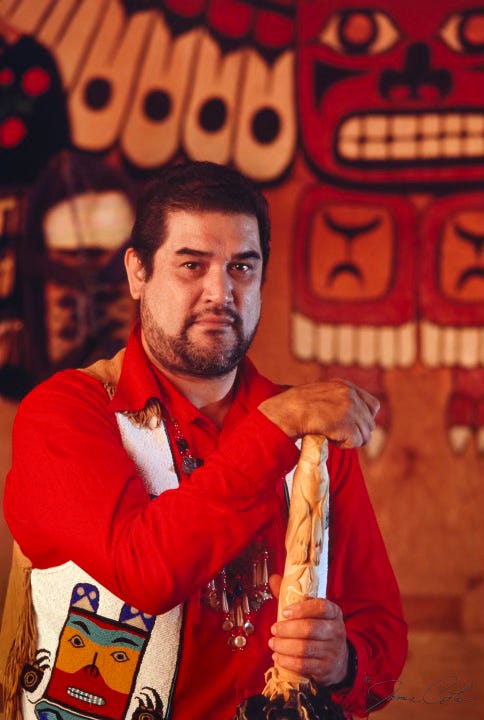
Through an 1855 treaty, the lands of the Twana peoples** were reduced to a 5,000-acre reservation. What followed was a systematic national policy of forced assimilation, one imposed on Indigenous peoples across the continent. In 1870, a boarding school was opened for 26 years, followed by a shift to off-reservation industrial schools. For the Skokomish, the consequences were devastating. They were strictly forbidden from speaking Twana, their native language. They lost the accumulated knowledge of how to manage the river delta and the forests that were so much a part of their culture. Traditions, ceremonies, and ways of understanding the world that had been refined over thousands of years were suppressed within a generation or two.
“Miller” is itself a shadow of the boarding school era, when surnames were imposed.
Bruce’s Skokomish name was Subiyay.
Subiyay was a college graduate and a Vietnam veteran. In the early 1970s, he worked in New York City as an actor, dancer, and writer. But he was pulled home by everything he had absorbed as the youngest of fifteen children, raised among elders, stories from his great-grandmother, basketweaving from an aunt, fragments of the Twana language, and a deep knowledge of the forest, the berries, and the plants of the peninsula.
He came back to learn what he didn’t yet know, and to give back what he did.
For the rest of his life, Subiyay served as the tribe’s cultural and educational director, dedicating himself to sustaining what had nearly been lost. He became the keeper of more than 120 traditional stories, some taking days to tell, and built a large repertoire of songs, dances, and ceremonial knowledge. He brought winter ceremonies back to his people and helped revive the First Salmon and First Elk ceremonies, once banned by the U.S. government. He was a master of basketry, textile weaving, and wood carving, and made ceremonial regalia and masks. Critically, he was also one of the last people who could speak the Twana language, and was working urgently to record as much of it as possible before it disappeared entirely.
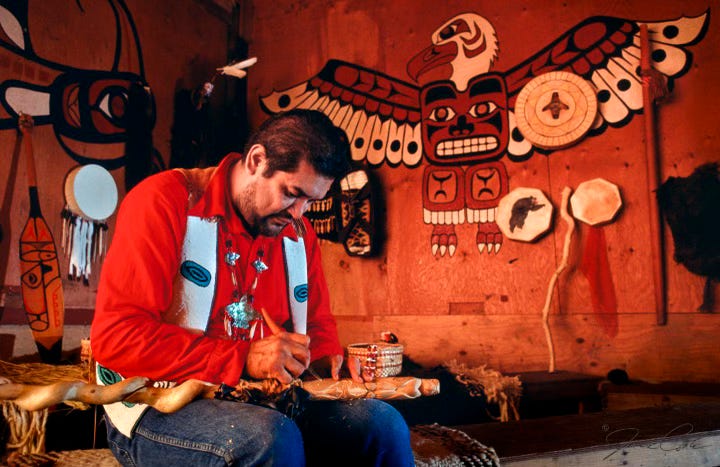
For the portrait we would make together, he chose to be shown in the longhouse he led the effort to build in 1982, the first traditional longhouse on the Skokomish Reservation in more than 110 years.
Subiyay understood what it meant to watch knowledge vanish, one voice at a time.
He once described it as, “Seeing your teachers disappear is like a forest standing healthy, then over time a few are gone, then half, until there’s just one tree left. I realize I’ve become this forest and that my experiences must be passed along. I will teach whoever comes to learn. My immortality is the teaching I leave behind.”
Subiyay died in 2005 at age 60. His forest was not reduced to a single tree.
* The Makah and Quinault are the subjects of separate posts. Both are still in production at this writing.
** The Twana were a group of Indigenous communities along Hood Canal who shared a common language and culture. In the late 18th century they likely numbered between 1,500 and 2,500 people. Disease, displacement, and assimilation policies in the 19th century sharply reduced their population. Today, their descendants are largely represented by the Skokomish Tribe, the primary surviving Twana-speaking community, with roughly 800 enrolled members.